Call list
The complete history of your calls, with filters and an export. This is the screen you use to find proof of what actually happened.
The columns
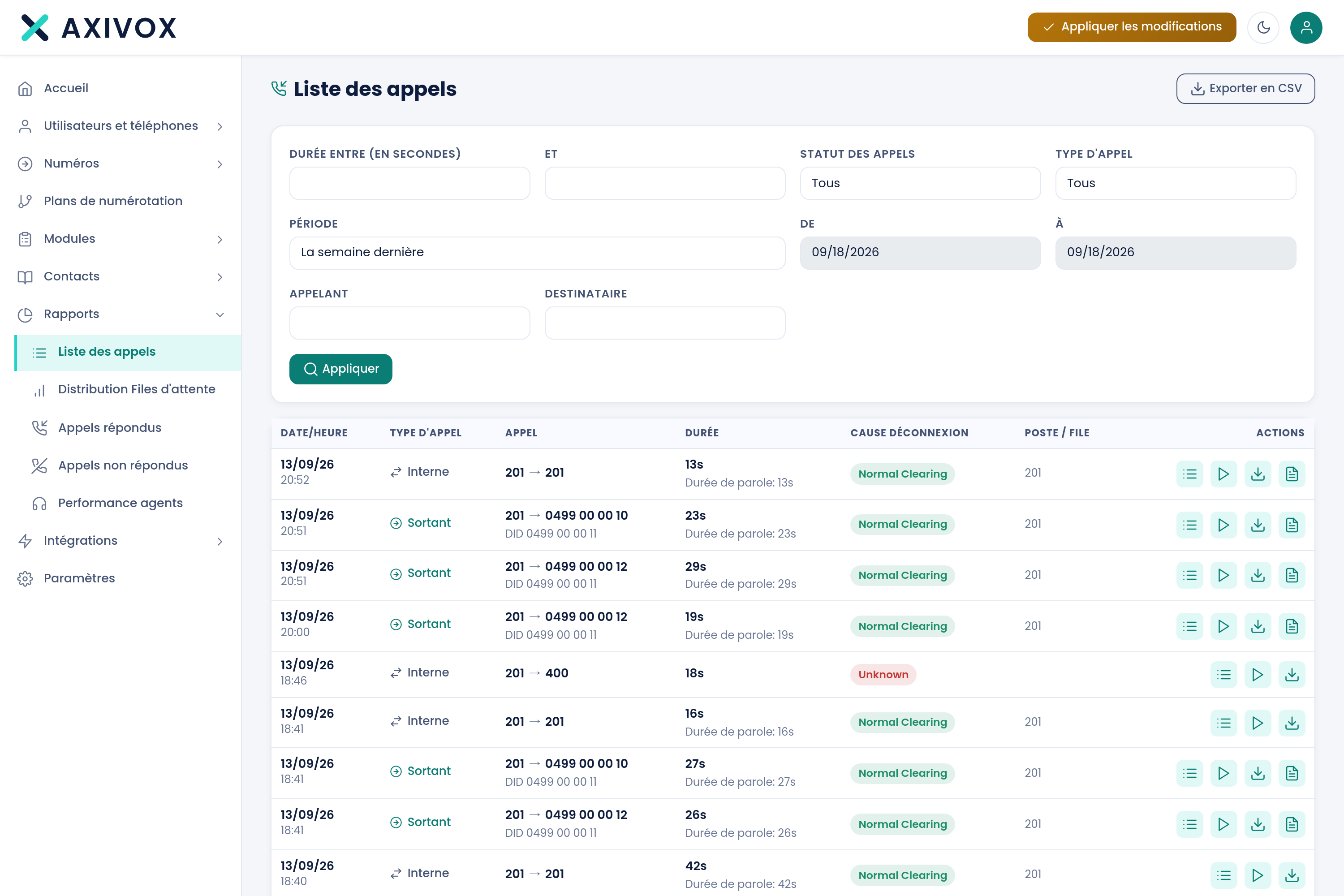
| Column | What it shows |
|---|---|
| Date and time | The moment of the call |
| Call type | Inbound, outbound or internal |
| Call | The parties involved |
| Duration | The total duration, with talk time below it |
| Disconnection cause | Who hung up, and why |
| Extension or queue | The extension or queue that handled the call |
| Recording | The recording, if one exists |
The filters
Eight filters, which can be combined.
| Filter | Values |
|---|---|
| Call status | Answered, Unanswered, All |
| Call type | All, Inbound, Outbound, Internal |
| Period | Today, Yesterday, This week, Last week, This month, Last month, or Other |
| From and to | Two dates, when you choose the "Other" period |
| Caller | A number or a name |
| Recipient | A number or a name |
| Duration between and | Two bounds in seconds |
The Apply button runs the search. The number of results is shown above the list, which you browse page by page.
Exporting
The Export to CSV button produces a file of the current selection, with filters applied. This is what you use for analysis in a spreadsheet, or to hand over a record.
Diagnosing a complaint
The sequence that works, when a customer claims they couldn't reach anyone:
- Filter on their number in Caller, for the period concerned.
- Check the status: did the call arrive, and was it answered?
- If unanswered, check the extension or queue: where did it ring?
- Check the disconnection cause: did they hang up themselves, or was the call cut off?
These four pieces of information are almost always enough to tell apart a call that never arrived, a call that arrived at the wrong place, and a caller who didn't wait.
What each report measures, and how to read it
See the Queues and statistics page