One call, one queue, several agents
The queue holds the call, distributes it according to the rule you chose, and keeps track of everything.
- The strategy changes on a live queue
- When the wait time runs out, the call carries on in the plan
- Nothing is lost, everything is measured
You choose how the calls are spread
The strategy changes at any time, on a queue that's already live.
| The rule | What it does | When to pick it |
|---|---|---|
| All at once | Every available agent rings together | Small team, priority on speed to answer |
| Longest idle | The agent who hasn't taken a call for the longest time | Spread the load fairly |
| Fewest calls | The agent who has taken the fewest calls | Balance over the day rather than the moment |
| Random | An available agent picked at random | No particular fairness rule |
| One after another | Agents in a cascade, in list order | An escalation hierarchy, from first line to second |
| Restarting from the first | The cascade, but always from the top of the list | A lead agent who must see every call go past |
The queue's, and the ring's
A queue caps the total time spent waiting, and separately the time of a single attempt at an agent. Confusing the two is the most common mistake.
- The first decides when the call leaves the queue
- The second decides when it moves to the next agent
Two ways to staff a queue
Permanent agents
Agents attached to the queue for good, always in it.
- They ring as soon as a call enters the queue
- Nothing to do in the morning, nothing to undo in the evening
- The right choice for a dedicated team
On-demand agents
Agents who log in and out themselves.
- Each one joins the queue when they're available
- A one-off reinforcement that doesn't stay
- The right choice when the queue isn't the main job
What each of the two durations caps
A queue has a maximum wait time, which caps the total time spent in the queue, and a maximum ring time at an agent, which caps the time of a single attempt. Confusing the two is the most common mistake: the first decides when the call leaves the queue, the second when it moves to the next agent.
When the wait time runs out, the call isn't lost: it carries on in the dial plan, to voicemail, another department or a voice agent.
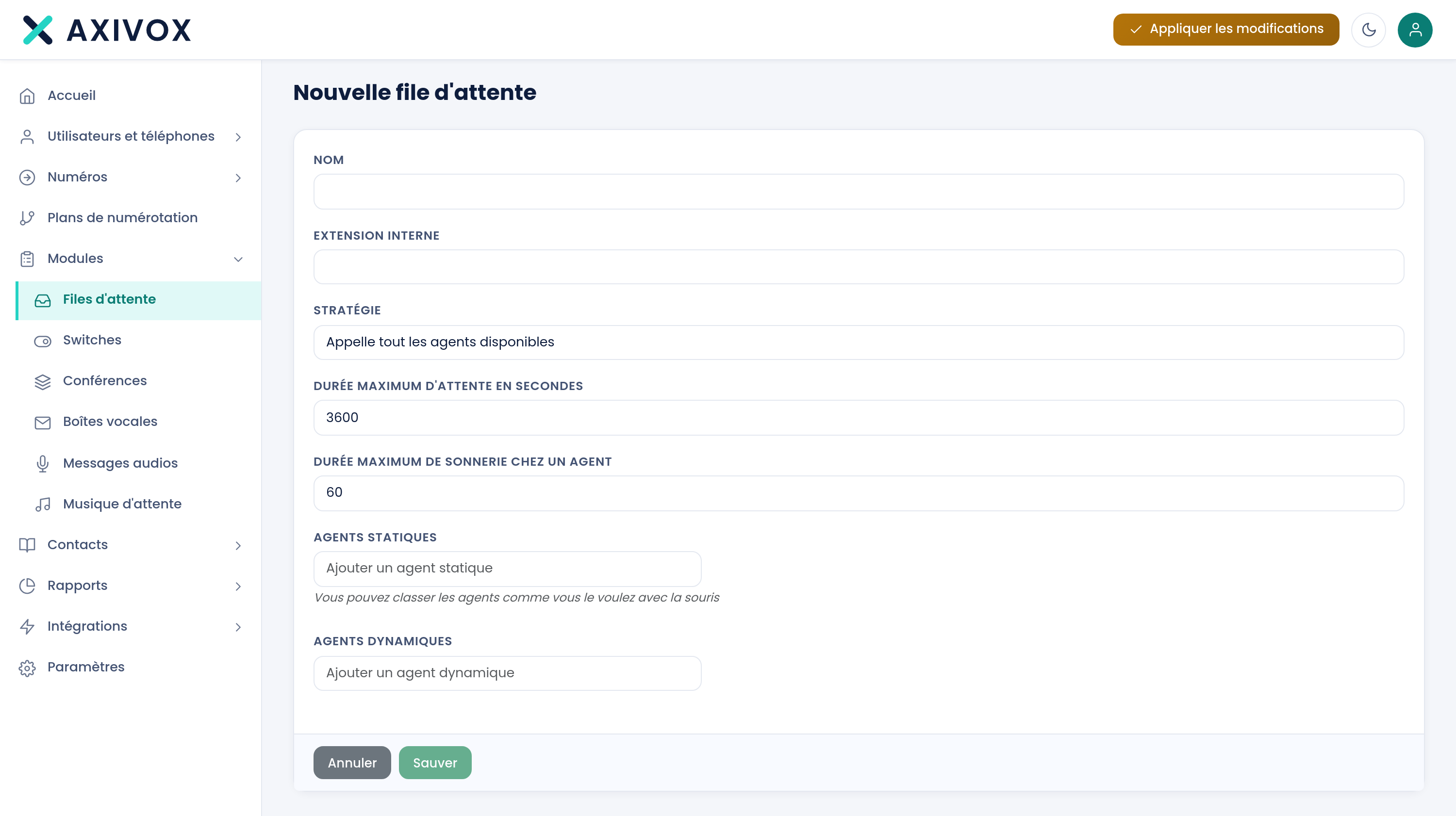
Seven fields, and the queue runs
A name, an internal number, a strategy, two durations, and the list of agents. That's the whole form.
- No option hidden behind an add-on
- Editable while the queue is taking calls
You don't improve what you don't measure.
See what time it rings
The distribution report shows call volume by time slot. It's often the first surprise: the peak isn't where you thought.
- Over the period you choose
- Readable with no export, no spreadsheet
Four reports and a wallboard
Reports cover the period you choose, and read with nothing to export.
| Report | What it shows |
|---|---|
| Distribution | Call volume by time slot, to see where your peaks are |
| Answered calls | Every call taken, with the wait before answer and the agent |
| Unanswered calls | Calls that left the queue, and why |
| Agent performance | Per agent, calls taken and time spent on the line |
| Wallboard | The queue's live state, displayable on a wall screen |
The call list, beyond queues
Every call in your organisation, filterable by status, direction, period, caller, destination, and even by duration between two bounds. Exportable to CSV when you need it out of the interface.
The duration column keeps total duration apart from talk time. They aren't the same figures, and confusing the two makes a report say anything.
The guide details every filter, every column and every report.
Open the guideHow many calls are you losing, and at what time?
If the answer is “we don't know”, that's the first figure we'll show you.