Your incoming numbers
The numbers you hold are ported, and you order more in about a hundred countries. Each one connects to your trunk, and it's up to you to route it inside your system.
Your phone system suits you, it's the phone link you want to revisit. A SIP trunk connects your IPBX to our network: incoming calls arrive on it, outgoing calls go out through us, and your extensions keep working exactly as before.
Many businesses have an IPBX that does exactly what's asked of it, and a carrier bill that no longer keeps up: numbers billed one by one in a single country, capacity that can't be adjusted, and a wait for every change.
The numbers you hold are ported, and you order more in about a hundred countries. Each one connects to your trunk, and it's up to you to route it inside your system.
You reserve a number of calls you can hold at once, not a number of physical lines. It's revisited whenever your activity changes.
Nothing to redo on the phones: they keep talking to your IPBX, which talks to our network. The change stops at the link.
Your IPBX registers with us using SIP credentials, like any standards-based device. No box to insert in between.
Your IPBX, your numbers, your minute volumes and the number of calls you need to hold at once. That's what sets the sizing, and the price.
We create the link on our end and give you the credentials to enter into your IPBX. Its documentation calls this a SIP trunk or a carrier account.
A temporary number lets you call and be called over the new link, while the old one keeps working.
They're ported, or forwarded for the length of the transition. The switch-over is scheduled outside your business hours.
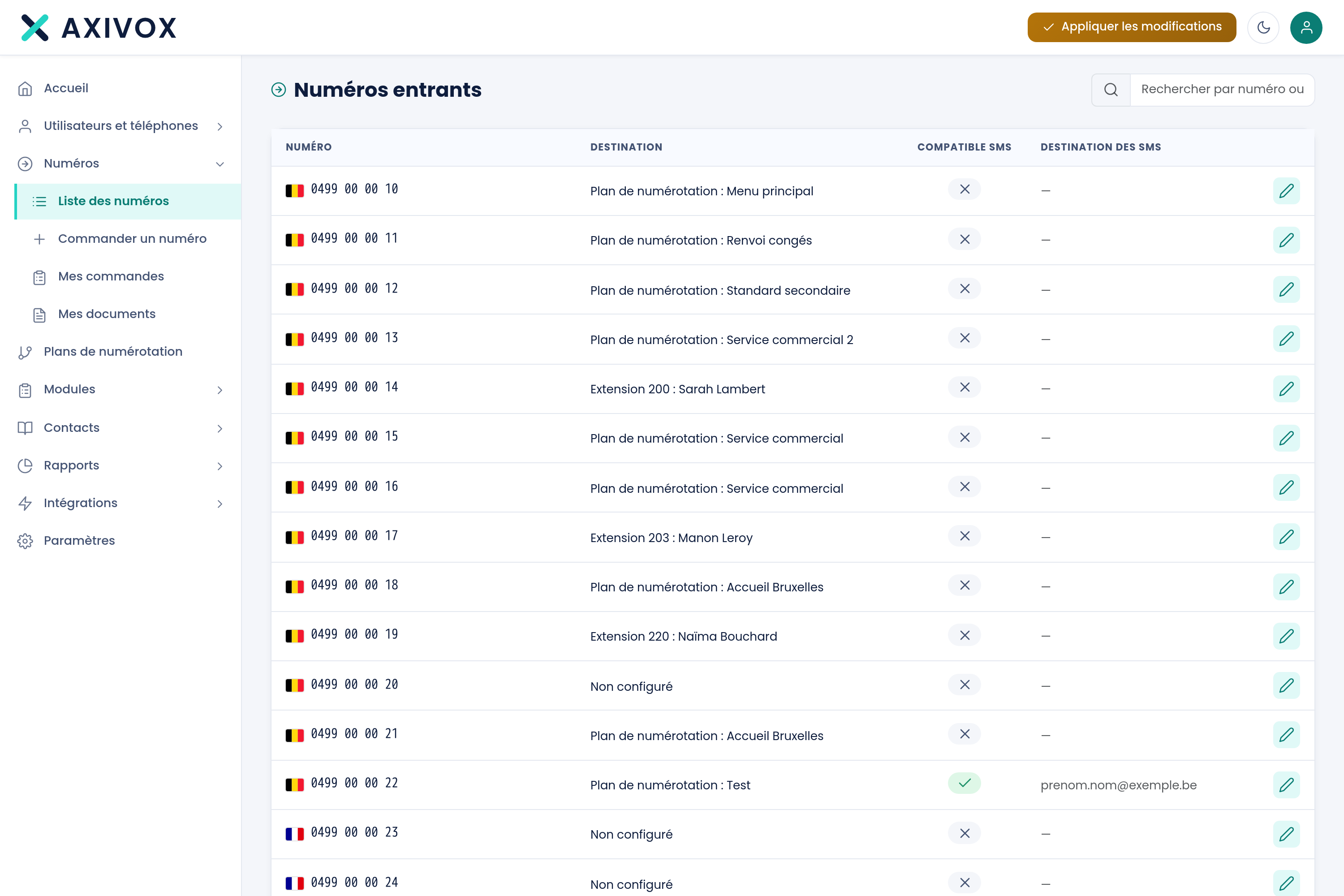
Even when our phone system isn't in use, you keep control of your numbers: the catalogue, the orders, where each one is routed and your call list.
It's the figure that sizes a trunk, and the one nobody knows. It isn't derived from your headcount: an office team often gets by with one simultaneous call for every four to six people, a call center comes close to one to one.
The trunk commits you to nothing more. The day your current system becomes a burden, the same account carries a full hosted phone system, with extensions, greeting and queues.
Our article explains how to estimate your simultaneous calls without being off by a factor of two.
Read the articleGive us your monthly minutes, your main destinations and the number of calls you need to hold at once. We'll come back with a figure.