A local number, a team elsewhere
A Madrid number can ring in Brussels, and a Belgian number at a colleague's desk in Lisbon. The number fixes where your customers call you, your team stays where it is.
- Ten numbers can point to the same greeting
- Your current numbers are ported or forwarded
Five steps, in your interface
You order and track progress in the same place. Every order is checked before it's sent to the carrier, which avoids applications rejected for a missing document.
You choose the country
The list shows, for each country, how many zones are available.
You choose the zone
A city, a region, or a national number, depending on what the country offers.
You check the documents required
Some countries require proof of identity, a local address or an ID document. The interface tells you before you order, not after.
You track the order
The status of the request is visible in your interface up to activation.
You connect the number
Extension, dial plan, voicemail, conference: the destination is chosen and changed at any time.
Be local wherever your customers are, with no office there.
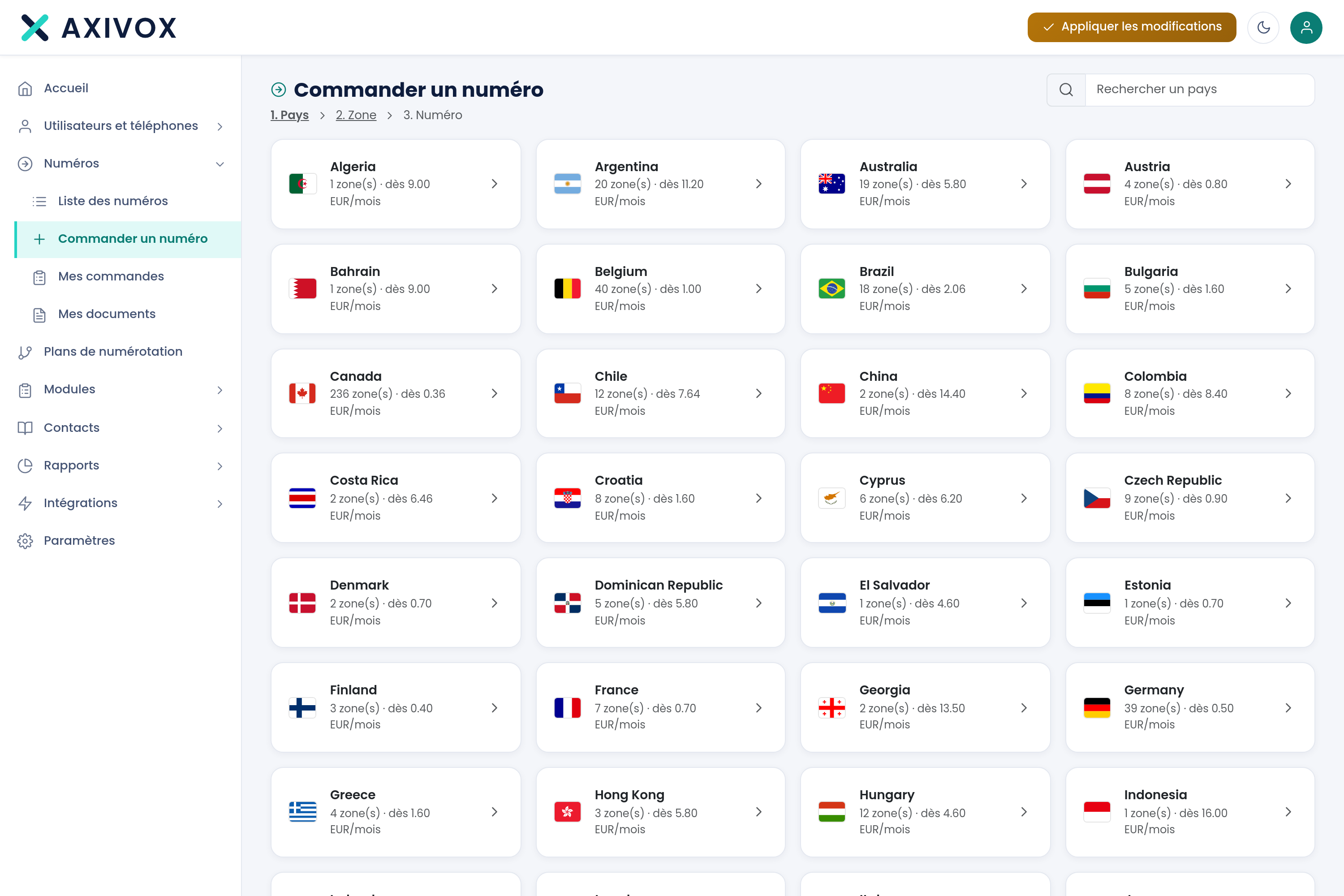
The catalogue and order tracking
You choose, you order, you track the status of the request up to activation.
- The documents a country requires show before you order
- The number's destination can then be changed at any time
The 65 countries orderable online
These countries are already loaded in your interface: you choose the zone and place the order. The number of zones gives the precision of the local choice: the higher it is, the closer you get to a specific city. For other countries in our coverage, ask us, adding one to the catalogue takes a few days.
Three types of numbers, and your own
Local, national or mobile
Depending on the country, you choose a local number tied to a city, a national number, or a mobile number. Some destinations also support SMS and SIP trunking.
Allocation follows local regulation
Availability depends on each country's rules. Depending on the legislation, documents may be required to verify your identity, your address or your business. The interface tells you before you order, and our team helps you put the file together.
Porting your existing numbers
Porting a number follows a procedure set by the national regulator, specific to each country. We build the file with you and follow the request through to the switch-over.
Three common uses
Test a market without opening an office there
A local number is reassuring: your prospects call a number from home, at home rates. If the market doesn't work out, you hand the number back without having signed a lease or hired locally.
Several numbers, one greeting
Ten numbers can point to the same dial plan. You open a market without rewriting your greeting, and later measure which number brings in what.
And your current numbers
Your existing numbers keep working: they're ported, or forwarded for the length of the transition. Nobody has to reprint a business card because of a change of carrier.
Tell us where you want to be reachable.
We'll look together at what the catalogue offers for those cities, and what each country asks for as proof.