The dial plan is drawn and written by AI, the call queries your software live, the analysis of your conversations stays on our servers. And everything a phone system should do, obviously, is set in the same interface.
Business telephony looks the same from one provider to the next. Six functions we built ourselves, and that your teams run without ever having to call us.
Your dial plan, drawn and written by AI
Describe your greeting in one sentence. The assistant builds the plan, creates the announcements that are missing, and shows you the diagram. Nothing replaces your current plan until you've confirmed it. Then you fine-tune it with your mouse, module by module. Nobody else offers this.
The call queries your software, live
While the phone rings, the dial plan questions your CRM or any API, keeps the answer, and decides what happens next: a key account to its sales rep, an overdue invoice to accounting. A phone system that reads your data, not just one that rings.
The call analyses itself, and it stays with us
Transcript, summary, tone of the exchange, themes, flagging what deserves a follow-up call. All of it produced on our own servers, in Europe, with no external AI service ever hearing your calls.
A softphone that acts inside your CRM
From the call, you open a ticket in the right team, an opportunity, an activity, a signature request, under your own name. You transfer a call by dragging it onto a colleague, and take it with you on your mobile with one tap. The handset can't do any of that.
The tools of a contact center, in your phone system
Queues, wallboard on a wall screen, four reports, statistics on queues and ordinary calls, listen, whisper and barge-in to coach an agent. Call-center tools, in a system you administer yourself.
A voice agent that picks up for you
At times when nobody can take the call, or as a first filter, a voice agent answers in your name, understands the request, qualifies and transfers it. It sits in the dial plan like any other module, next to the rest.
And the rest
Everything you'd expect from a phone system, obviously
None of the above would come at the expense of the basics. They're here, in the same interface, run by your teams. We don't boast about it: it's the bare minimum.
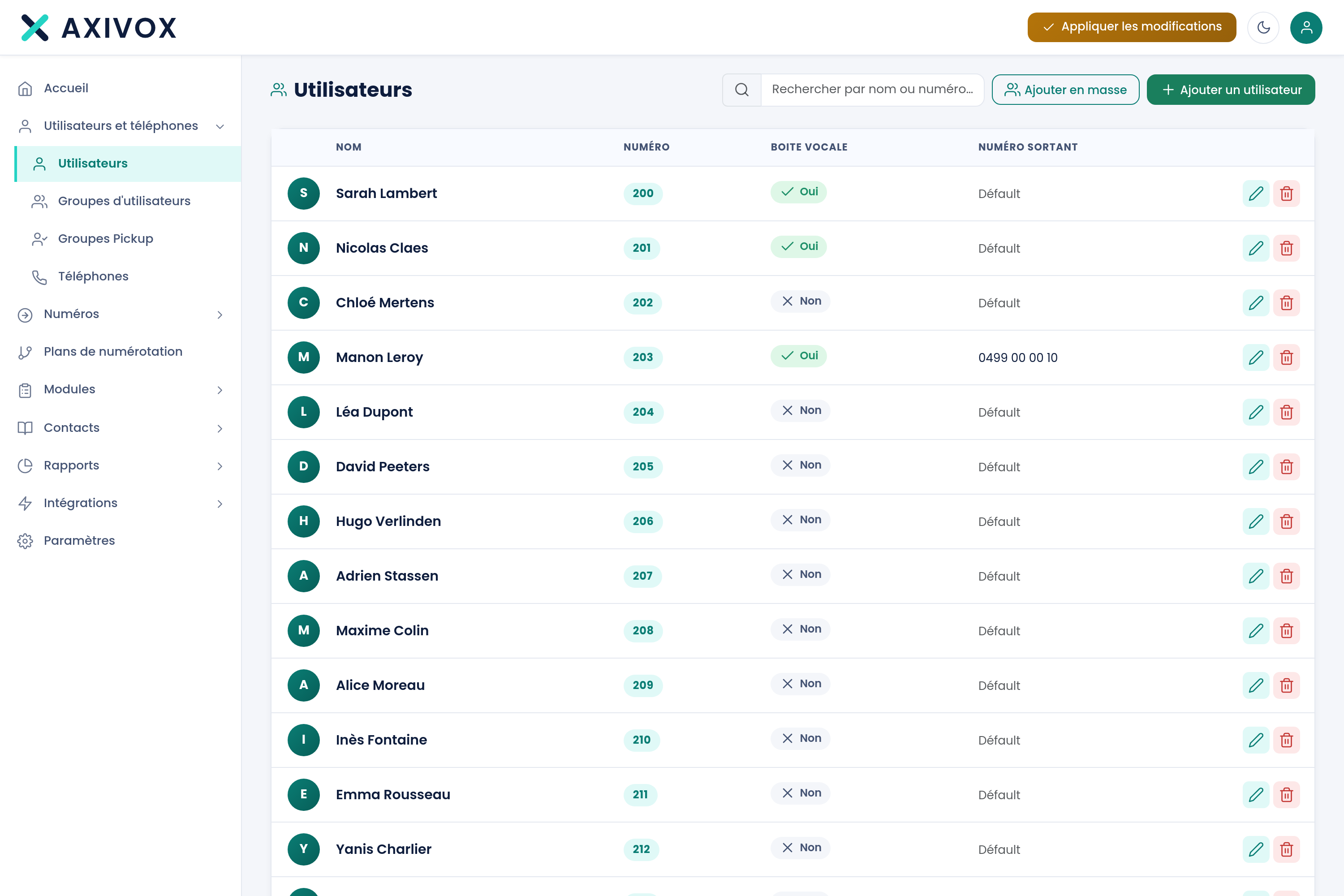
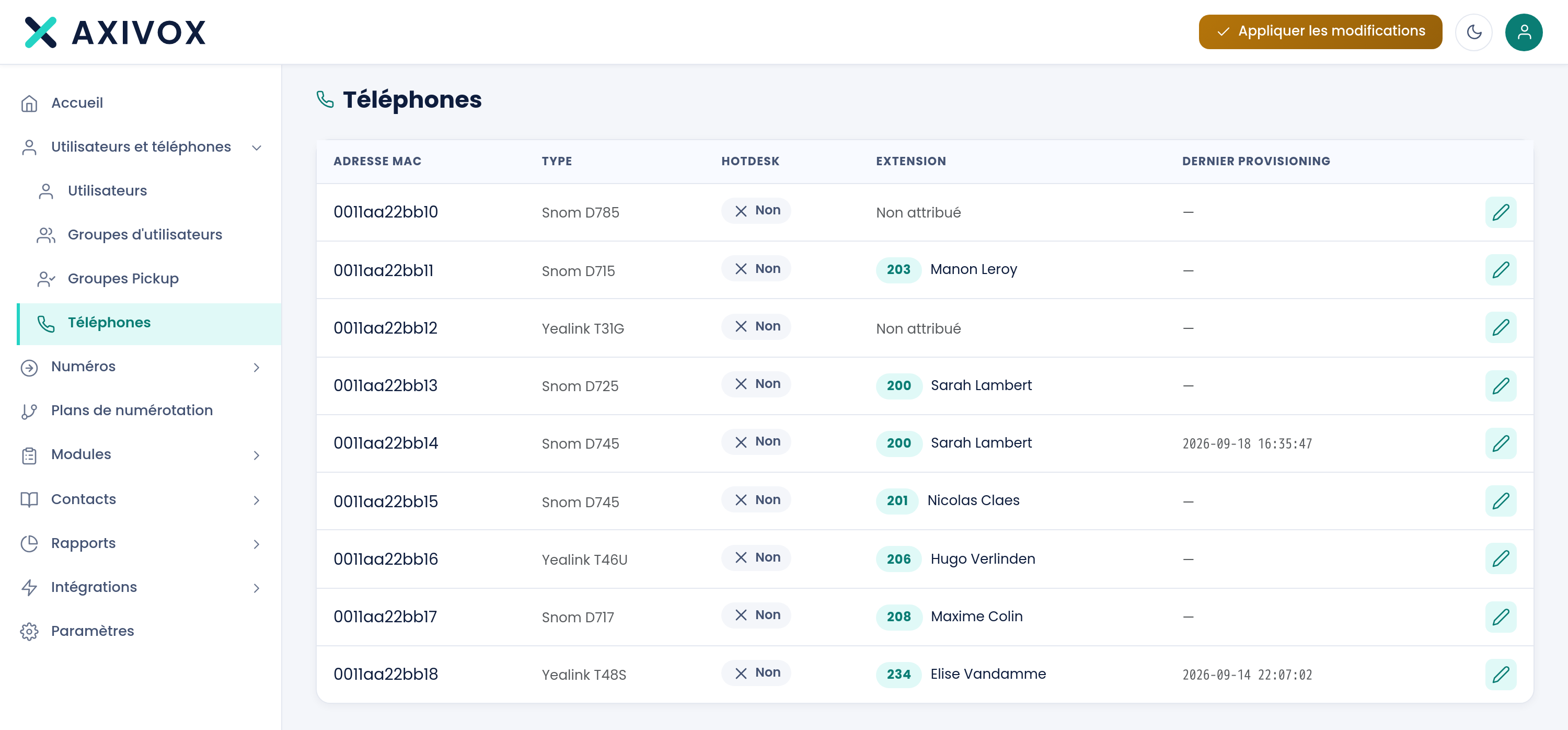
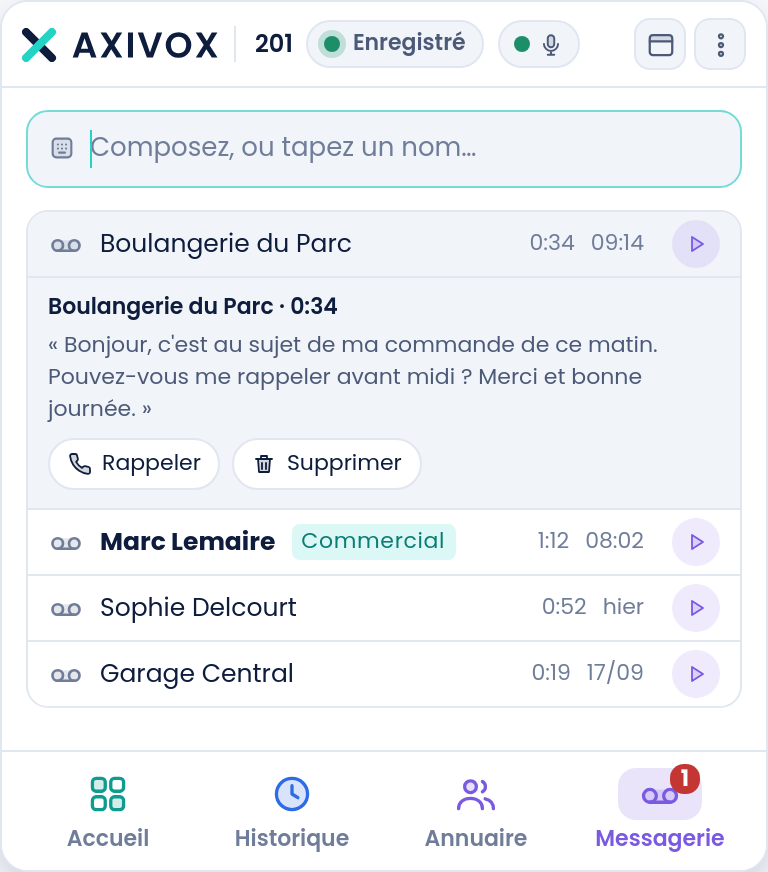
Extensions and phones set up in six tabsNumbers in 100 countries, each one redirected in two clicksAny SIP phone, Snom and Yealink with zero setupVisual voicemail: your messages, transcribed and readableText-to-speech for your announcementsConferences and call pickupShared directories and blacklistHotdesking: your extension follows you from one phone to anotherOn-call switches, flipped with one tapDial from your desk phone
The interface
What your teams open every morning
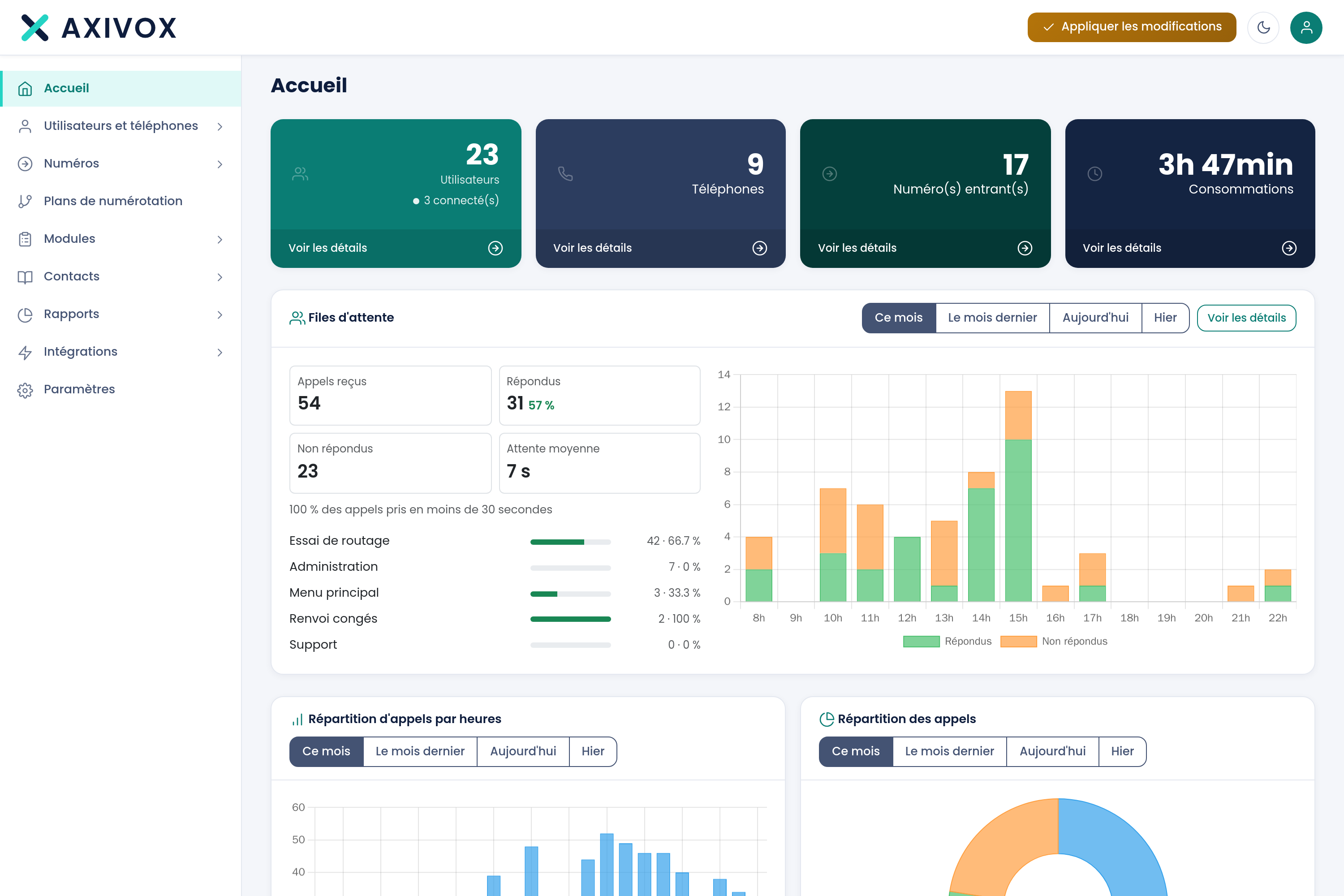
The dashboard answers three questions at a glance: how many extensions and numbers do you have, how are your queues doing, and how much have you used.
You prepare a change, review it, and it takes effect the moment you click Apply. So you can redesign your greeting in the middle of the day and only switch it on that evening.
What you gain
Four reasons to trust us with your telephony
Simplicity
Your teams stop waiting on anyone
Creating an extension, changing a destination, opening on-call duty: a few seconds, done by your teams, no ticket and no waiting.
Flexibility
The system follows your organisation
The path of your calls is drawn like your org chart. The day your organisation changes, you redraw it yourself.
Artificial intelligence
A voice agent that picks up at night
It understands the request in natural language, books an appointment, and hands off to a human with the full context.
Integrations
Your telephony talks to your software
Odoo both ways, and your own systems queried during the call to route to the right place.
Quote
Show us your organisation, we'll show you its dial plan.
Thirty minutes on a video call, with a platform engineer.
You leave with the diagram of your routing and a price
No installation, no commitment
Reply within one business day
A question?We reply within moments.
Your replies are used to handle your request.
Privacy